
Animation of MFI Thorax (Quan Gan)
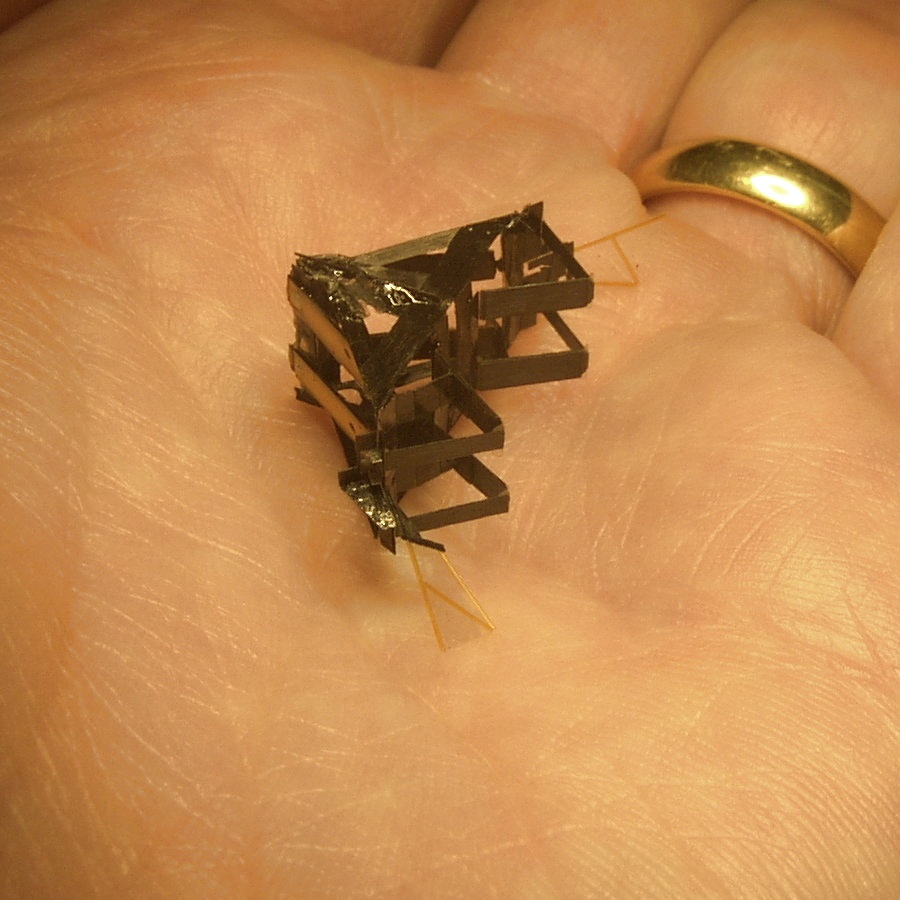
MFI Evolution 1999-2006

IR triggered left turn
IR triggered right turn
Centimeter-scale robots will create the opportunity to manipulate, sense and explore a wide range of environments with greatly reduced cost and expanded capabilities. In many applications, the capability of millirobots depends on mobility, multiplicity, and intelligence. For intelligence, sensing and computation capabilities are now almost available off the shelf. However, there are significant challenges for millirobots in creating all-terrain capable mobility, and low production costs for multiplicity. Although many man-made materials exceed natural materials in performance, surprisingly it has turned out that millirobots use such high loads that material strength is a significant limitation.
The mesoscopic range between MEMS and conventional robots provides a new domain with rich challenges. There are advantages to this size scale for novel low-cost fabrication methods, including rapid prototyping of millirobots from kits of parts. This talk will provide an overview for the key challenges in millirobots for materials, design, fabrication, actuation, control, sensing, and power, illustrated by examples in legged and winged millirobots made using carbon fiber.
|
Animation of MFI Thorax (Quan Gan) |
MFI Evolution 1999-2006 |
IR triggered left turn |
IR triggered right turn |
 Design, Fabrication and Initial Results of a 2g Autonomous Glider
Flexure Design Rules for Carbon Fiber Microrobotic Mechanisms,
Microrobotics using Composite Materials: the Micromechanical
Flying Insect Thorax,
Lift Force Improvements for the Micromechanical Flying Insect
Design, Fabrication and Initial Results of a 2g Autonomous Glider
Flexure Design Rules for Carbon Fiber Microrobotic Mechanisms,
Microrobotics using Composite Materials: the Micromechanical
Flying Insect Thorax,
Lift Force Improvements for the Micromechanical Flying Insect
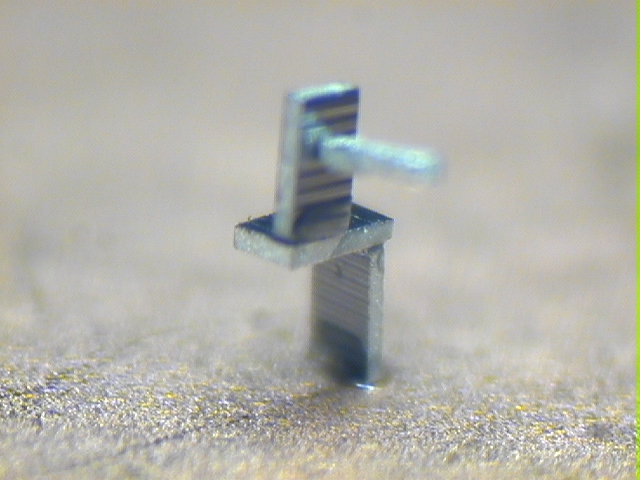
Micropart Assembly Movie |

Semiconductor Strain Gauge Assembly Movie |
Towards a 3g Crawling Robot through the Integration of Microrobot
Technologies
Carbon Fiber Components with Integrated Wiring for Millirobot Prototyping,
Automating Microassembly with Ortho-tweezers and Force Sensing,
Prototyping Millirobots using Dextrous Microassembly and Folding